A First Visit to a Local Meeting: What to Notice in the Room
A first visit to a local meeting is easier to follow when you know how to read the room, track unfamiliar terms and identify sources of information.
A first visit to a local meeting is easier to follow when you treat the room as a source of information, not just a place where people speak. The seating, signs, agenda and displayed materials can help you understand how the meeting works even if you are new to the area or its local terms.
Imagine Rowan attends a fictional neighbourhood committee meeting in a library room. A notice has mentioned a discussion about a bus stop, and Rowan plans to listen rather than speak. By looking for practical clues before and during the meeting, Rowan can keep track of the issue without needing to know every local procedure.
What can you learn from the room before the meeting?
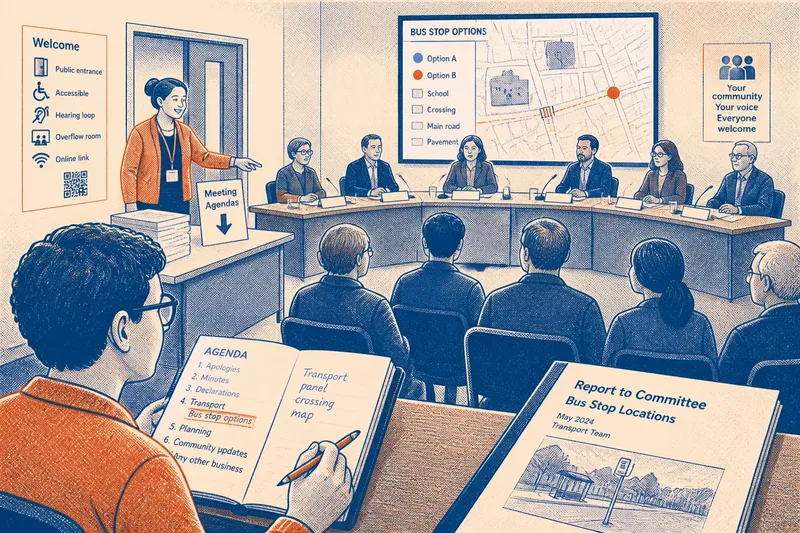
Rowan sees tables arranged in a horseshoe, rows of chairs behind them and printed agendas near the entrance. The arrangement suggests where committee members and visitors are expected to sit, but it does not establish who has authority or whether visitors can contribute.
Look for a public entrance, a welcome desk, name plates, microphones, a screen and notices about access. If the meeting has an online link or an overflow room, check where those are explained. Choose a seat from which you can hear the speakers and see any displays, while keeping doors and access routes clear.
In this imagined situation, a staff member points Rowan to the agenda table and the unmarked public chairs. Rowan now knows where to get the meeting papers and whom to approach for basic orientation. If you are unsure where visitors should sit, asking a staff member or the meeting clerk is a simple way to check.
How do you follow the agenda without knowing local shorthand?
An agenda lists the business expected at a meeting. It may say whether an item is for information, discussion or a decision, but wording differs between councils, committees and neighbourhood groups. Treat each heading as a signpost rather than a complete account of what will happen.
Rowan marks the bus-stop item with a pencil and uses a page reference to find its report. The meeting deals with a short administrative item first, then moves to transport. Following the printed order and matching each item to its paper is more manageable than trying to read every document at once.
Listen for the chair naming an item, explaining its purpose or inviting someone to present a report. Notice whether speakers refer to a paper, ask questions or explain a process. These cues help you follow the meeting’s sequence without needing to interpret every local expression immediately.
When a speaker uses an unfamiliar committee name, abbreviation or service term, write it down alongside the agenda item. Rowan notes “transport panel” and “crossing map” rather than guessing what either phrase means. The report, council website or named staff contact can then help connect the term to the issue.
How can you read maps, papers and local place names?
A report’s title, date, author or responsible team can help you identify the document later. When a map appears, check its labels and legend as well as the marked options; these details show what the drawing includes and how its symbols should be read.
In Rowan’s fictional meeting, a screen shows two possible bus-stop locations, while the report mentions access to the pavement. Speakers also refer to a nearby crossing and a route from a school. Rowan can see that the map covers the proposed locations, while the conversation raises details that are not shown on it.
Official papers may use formal street or site names, while residents use local nicknames or nearby landmarks. If the names seem different, check the map or ask which place is meant rather than assuming they refer to the same spot. If a paper is missing or a display is hard to read, note its title and ask the clerk how to find it after the meeting.
What should you observe when the meeting changes course?
A chair may pause while members read, move an item because someone is absent or allow questions after a report. A clear explanation helps visitors follow the change; if none is given, note what you saw and check with the clerk later rather than assuming an item has been postponed.
In the imagined meeting, a committee member asks an officer to explain a phrase, and the officer points to the map. The chair later says the written recommendation will be amended to mention the crossing concern. Rowan observes how the chair identifies the change and checks whether members agree, without needing to decide what the change means for the wider issue.
Keep separate notes for what happened and what remains unclear. Rowan writes that the group discussed a preferred location, then adds, “Was anything else explained about the site?” This keeps an observation distinct from an assumption and gives Rowan a focused question to follow up.
What questions help you follow a first visit?
Who is chairing the meeting?
The chair guides the order of business and signals when the meeting moves to another item. Check the agenda, name plates or opening remarks for the chair’s name and role.
Where can I find the meeting papers?
Look for printed agendas near the entrance, a QR code on a notice or the meeting page on the council website. If a report is not available, write down its title and ask the clerk or listed contact where it can be found.
How can I keep track of an unfamiliar local term?
Write the term beside the agenda item and note who used it. After the meeting, check the report or council website, or ask the named staff contact for a plain explanation.
What should I do if I cannot see or hear clearly?
Try another available seat or ask a staff member whether the room has a microphone, hearing support or a better viewing position. If a document or display remains unreadable, note its title and ask how to access a clearer copy.
What is useful to check before you leave?
- Check whether you have the agenda; if you do, keep it with your notes, and if you do not, ask for a copy or note where it is published.
- Check whether each paper you needed has a title and date; if both are visible, record them, and if either is missing, ask the clerk how to identify the correct document.
- Check whether you can read the map legend and labels; if you can, note the places or options shown, and if you cannot, ask for a clearer copy or an explanation.
- Check whether an unfamiliar term appears in a paper; if it does, note the page or heading, and if it does not, record who used the term and ask the relevant contact later.
- Check whether you heard where follow-up information will appear; if a council page or contact was named, write it down, and if none was given, ask the clerk where updates are usually posted.
- Check whether the next meeting date or related body was mentioned; if it was, note the date or name, and if it was not, look for the committee’s future schedule on the council website.
Say Rowan has the agenda but cannot read the map’s small labels from the public seats. Rowan records the report title, asks the clerk for a clearer copy and writes down “Which streets do the two marked locations serve?” The immediate result is a specific follow-up question and a route to the relevant paper, rather than an unsupported guess about the map.
A first visit to a local meeting can be useful even when you remain an observer. With the agenda, paper titles, place names and a few precise notes, you can connect what you saw in the room to later information. Before leaving, check where the next update will appear; knowing where to look can make an unfamiliar local issue easier to follow.